Dashboards·terminal·MIT
turn-timeline
The current turn as a timeline per loop, where the time went and the slowest steps.
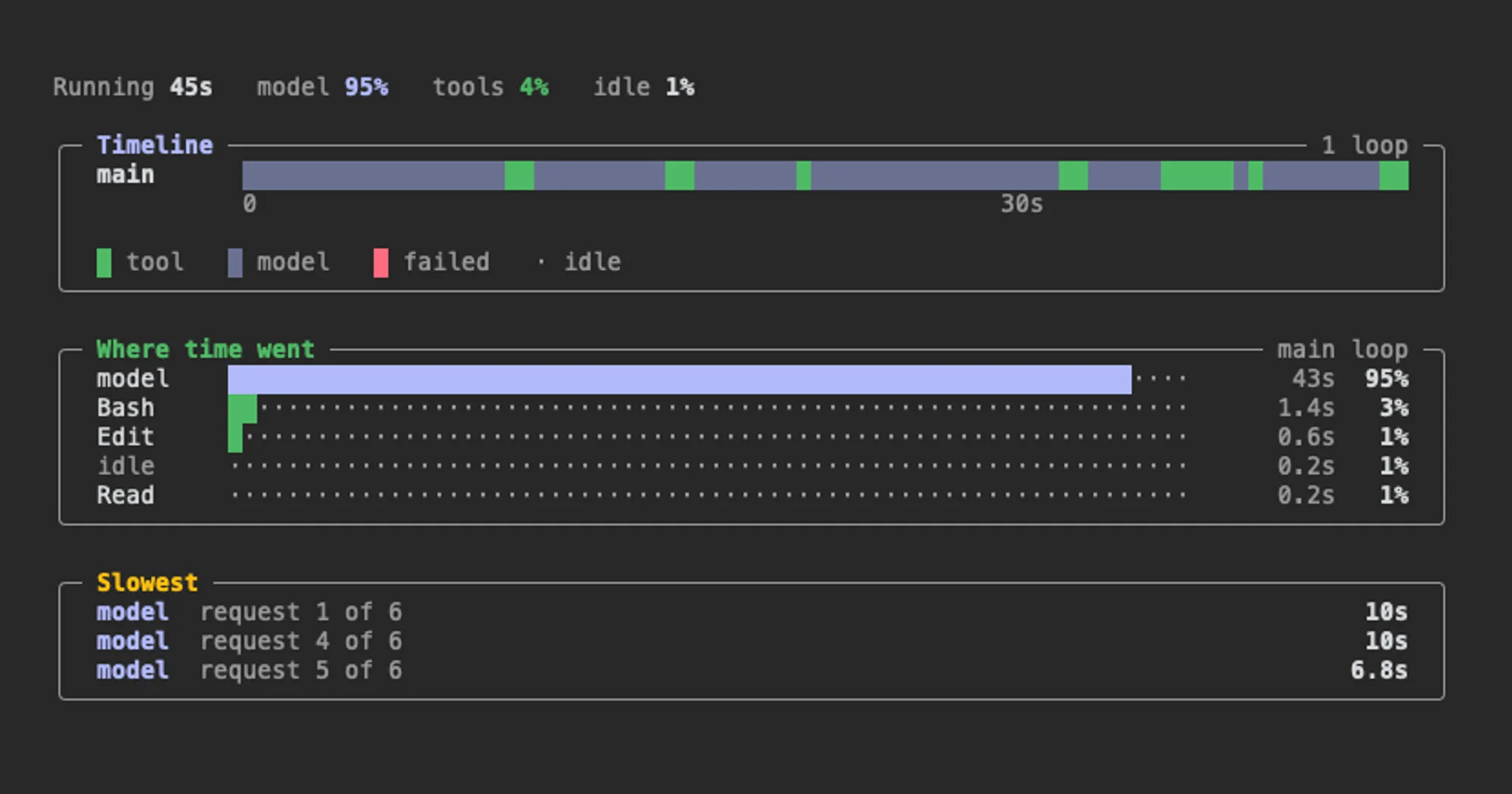
turn-timeline shows where the current turn’s time went. /timeline opens a pane that draws the turn as a timeline, with one lane for the main loop and one per subagent, the split between model, tools and idle, and the three slowest steps. It follows the running turn and keeps the last one after it ends.
What it does
- Top line: how long the turn has run, and the share spent in model requests, tools and idle.
- Timeline: one row per loop on a shared time axis. Green blocks are tool calls, red ones failed, shaded blocks are model requests and dots are idle time. Subagent lanes are named by type and numbered when the same type runs twice; Claude Code’s own background forks, such as compaction, show as
fork. A background subagent keeps drawing after the main loop ends. - Where time went: the main loop’s time split between the model, each tool by name and idle, with seconds and percentages.
- Slowest: the three longest finished steps, with their target (the command, file or pattern) or, for a model request, its place in the loop, such as “request 4 of 6”.
Install
Needs Claude Code 2.1.287 or later.
claude plugin marketplace add arasovic/claude-code-mods
claude plugin install turn-timeline@claude-code-mods
Restart Claude Code and run /timeline. The timeline starts with the next turn. When the pane cannot dock, the command replies with the reason it is waiting.
The same marketplace offers twelve mods, installed one at a time: cache-timer, change-ledger, compact-keeper, guardrails, image-peek, loop-guard, search-meter, secret-guard, session-meter, show-me, turn-footer and turn-timeline.
How it works
turn.start and turn.complete frame the turn, turn.step times each model request and tool.call times each tool call. To name a tool call’s target, the mod reads its input. Where time went is sampled across the turn: at each moment the oldest running tool counts, else a model request in flight, else idle. On the timeline a tool call wins a cell over a model request and any overlap counts, so short calls still show. The mod makes no network calls.
Limitations
- Where time went covers only the main loop; subagents appear on the timeline alone.
- A turn keeps its latest 400 steps, and lanes that do not fit the pane fold into a count.
- The author documents it only in the terminal.
More mods
The whole directory →
agent-flow
Every subagent of the session in a live tree beside the transcript. Zero tokens.
agent-profiler
Model wait, tools and subagents as shares of session time, live, with OTLP export.
todos
The repo's TODOs and FIXMEs above the prompt at session start, newest first.
budget-guard
Warns at 80% of a cost or plan-window limit you set, then refuses tool calls past it.